

As a freelance writer, it can be easy to get off track when you realize just how much work you have to complete.
Being flexible and creating a solid plan on how to use your time will help you make the best out of your time.
Without a writing routine, it can be easy to become trapped by procrastination and disappoint yourself when you don’t write as much as you’d like.
Further, it can be difficult to make writing a regular habit.
This is especially true for freelance writers working out of their home when there are kids to take care of, errands to run, laundry to clean, dishes to wash, etc., as well as those who may be working a full-time day job.
Below, we will discuss why a writing schedule is so important, how you can create a schedule that works for you, and a few apps that you can download and use to help better manage your time and keep track of your projects.
How to Create and Stick to a Writing Schedule as a Freelance Writer
Establishing a writing schedule is important for writers of all levels.
So, regardless of whether you are just starting out in the freelance world or you are a seasoned writer, you can benefit from a schedule.
So, how do you make a writing schedule? More specifically, how do you create a writing schedule that best suits you?
Let’s look at a few steps you can take to create a customized writing schedule.
1. Schedule Your Writing Time
You need to determine the best time of day that will allow you to work productively. This time needs to be worked around your daily routine.
Early morning is often a good time for writing, as the brain is fresh from a good night’s rest. However, if you have a day job on top of being a freelance writer or aren’t much of a morning person, then scheduling writing in after dinner may be better.
Try to keep the writing schedule from day to day to avoid any disruptions.
In addition, make sure to add your writing schedule on your daily planner or calendar. For some, this may make the writing seem like an obligation that must be kept.
Consistency can be tough to maintain, especially if your days are unpredictable (which, let’s be honest, they often are). But what matters more than the hour on the clock is your ability to protect those pockets of time like they’re tiny slices of gold. Even thirty minutes stuffed between errands can move the needle on your drafts, and you’ll be surprised how quickly progress piles up once you make that a habit — rough patches and all.
Also, don’t underestimate the value of setting clear boundaries with the people in your life. Explaining to your family, roommates, or whoever’s in your orbit that these particular blocks of time are “off limits” for interruption takes some of the pressure off you to juggle everything at once. Not everyone will get it right away, but holding your own schedule as real work is how others will start respecting it, too.
Sticking to a set time every day might sound simple until life actually happens. It’s funny, but sometimes you’ll find yourself writing in places you never intended: the kitchen counter while dinner simmers, or in the car outside your kid’s guitar lesson. The key is not beating yourself up if what works for other writers—those mythical morning pages people—doesn’t work for you. The world doesn’t care when the work gets done, only that it does, eventually.
Every so often, it helps to review your routine and ask yourself if it’s still really working. Maybe you’ve got a new gig or your home just got much louder. Feel free to pivot. Adjusting your schedule is part of the job, honestly, and doesn’t mean you’re failing—just arguably living as a real person. If you build that flexibility in from the beginning, you’ll end up with a process that actually endures beyond that first burst of motivation.
2. Prioritize Your Projects
It isn’t uncommon for freelance writers to have multiple projects going on at once.
For this reason, it is important to create a list of your projects and put them in order of priority.
For instance, if you have a project due Friday and another due the following Monday, the Friday project will take priority.
To help keep yourself accountable and on track, consider creating milestones and deadlines for each project.
3. Plan for Writer’s Block
Writer’s block happens to the best of all writers. In order to combat it, you need to be prepared for writer’s block to happen at any given time.
When writer’s block strikes, don’t simply sit there and stare at a blank document. Instead, indulge in some freewriting or daily writing prompts.
This will help get your mind back on track.
4. Create a Daily Word Count Goal
A daily word count goal can also help you remain accountable while motivating you to reach that goal. A daily word count goal can work whether you’re writing a book or blogs.
By meeting or exceeding your daily word count goal, you will feel as though you have accomplished something great. That feeling of accomplishment can take you into the next day.
5. Keep Your Files Organized
As a freelance writer, you will need to conduct research.
Rather than allowing this to take up part of your writing schedule, consider researching ahead of time, creating files, and organizing these files so they’re easily accessible when you sit down to write.
The easier you can make things on yourself, the easier it will be to get started writing on time.
Bonus Tip: Best Tools for Organizing Your Freelance Writing Routine
If you’re worried about staying organized and sticking to your freelance writing schedule, consider downloading an app or two that can help.
NaNoWriMo

Although not an app, NaNoWriMo holds an event every November where participants set a goal to write 50,000 words in a month.
You don’t have to wait until November (or even participate in this event) to set and reach a word count goal.
You can access the website at any time and enter your target date and word count goal. The website will then tell you the number of words that must be written each day in order to meet your goal.
You can go back to the site each day and update it with your word count, allowing you to see your progress.
Google Calendar
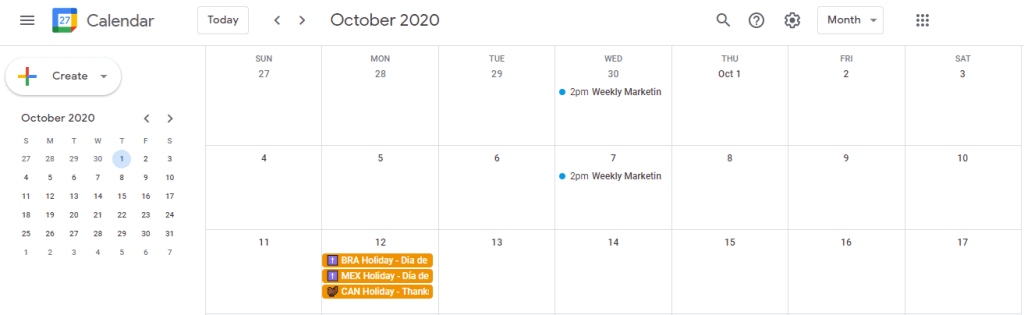
Google Calendar is designed to let you add tasks and events easily.
This app is free and will sync with your Gmail account. You will also receive 15GB of cloud storage on Google Drive where you can store important files safely and securely.
Google Calendar has a few features that are particularly useful for freelance writers, including app integration and mobile access.
Google Calendar connects easily with other Google tools as well as external apps like Trello and Asana. Google Calendar is accessible on your desktop computer, as well as your smartphone. This allows you to get notifications on the go.
There is also a Look Up feature that allows you to search public calendars to see if there are any webinars, podcasts, or other events that may be of interest to you and automatically add them to your own calendar.
Zoho Calendar
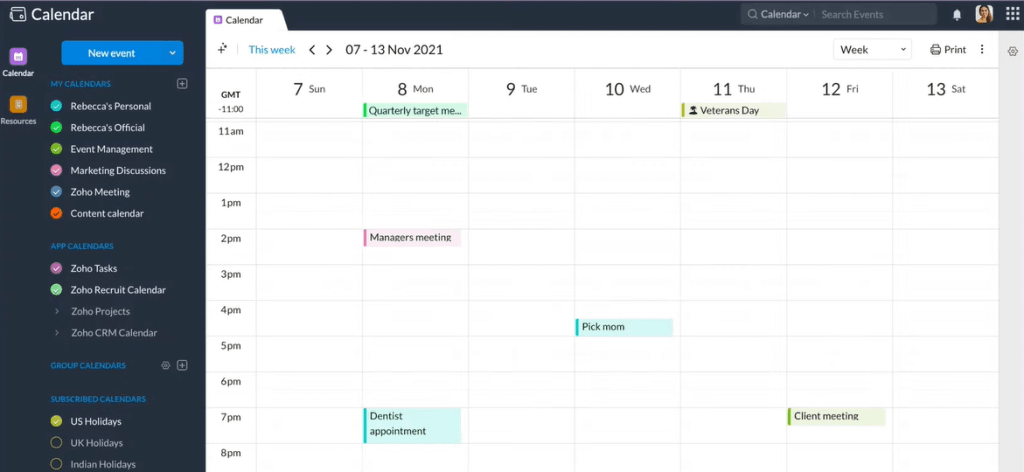
Zoho Calendar is a web-based calendar app that allows you to schedule and manage your tasks.
It has the ability to connect with other Zoho products like Zoho Mail, Zoho CRM, Zoho Campaigns, and Zoho Projects.
With the Zoho Calendar, you can share and publish your daily work with other team members, editors, or clients.
You can set deadlines, monitor progress, set reminders, and connect to your Google or Microsoft Outlook Calendar.
Zoho Calendar is available for free and is beneficial, but the free version doesn’t allow connection with other Zoho tools.
Asana

Asana is a project management tool that can not only help you stay organized, but it can help you plan your projects and communicate with your clients.
Rather than sending emails back and forth, Asana keeps everything regarding your project in one place.
Got a question? Ask it in Asana! Need to add notes to a specific task? Add them to Asana! Can’t remember the deadline for a project? Find it easily in Asana.
From planning and tracking individual project tasks to staying current on project deadlines, you can easily access and share all project-related information in Asana.
This will help you stay much more organized, allowing you to focus more on your writing.
You may also be interested in these articles:
- Learn the 12 Best Strategies for Cold Pitching to Get Business as a Freelancer
- 4 Freelance Writer Pitch Examples to Win Clients Over
- 9 Finance Tips for Freelancers to Help You Reach Your Goals
[/rock-biblioteca]
Wrap Up
Writing can be a challenge, but it is also incredibly rewarding.
The key is to create a writing schedule you can follow and stick to it. Although determining when you should write and finding the discipline to stick to a writing schedule, the long-term results will be well worth it.
A writing routine provides you with direction, regardless of whether you have a set deadline for your project.
It will also help you produce more engaging and higher-quality content, improving the chances of being hired by the same client again.