

Last week Google released the April 2025 Reviews Update which has a very strong focus on experience. The new documentation from the Google Search Center provides several guidelines on the type of content that the ratings system’s algorithm is looking for and was posted on April 12 on the official Google Search Twitter account.
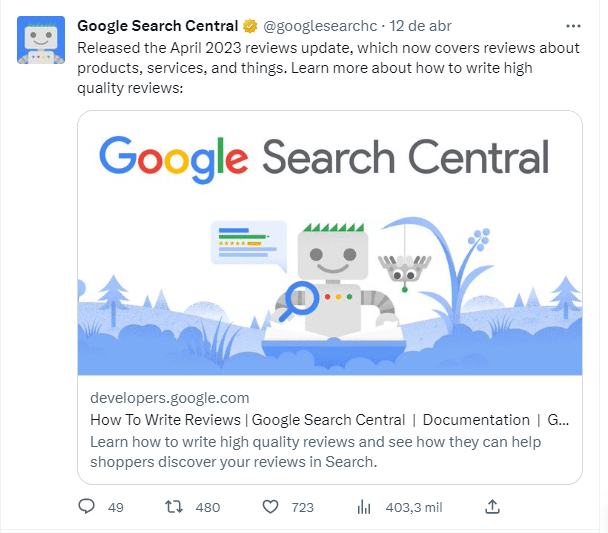
Update of evaluations
Google has changed the product reviews system to a review only system, showing that the new documentation applies to all assessment types and now also includes analysis of:
- Services and businesses;
- Destinations;
- Media (e.g. games, movies).
Google has even rephrased its article on how to write high quality reviews, which provided guidance on “product reviews” and now applies to all review types.
Always focusing on experience, the documentation encourages publishers to demonstrate evidence of experience through resources beyond just reviews in written form that show that the product has actually been handled, tested and used.
These other resources can be in the form of:
- Photos;
- Audios and videos;
- Links to experience evidence;
- Links to other useful resources (yours or from other sites) that help the reader make a decision;
- Product/service performance measurements;
- Comparison with competitors;
You know, sometimes it feels like too many reviews on the web are just copy-pasted fluff—folks who never even unpacked the box, let alone used the thing. With Google pushing for more real-life evidence, there’s less room for that kind of generic noise. If you’ve got a habit of actually putting products through their paces, your opinion’s suddenly worth a lot more. Publishers who rely on fake reviews or stock photos are probably having a rough go after this shift, but maybe that’s overdue. Genuine experience is—finally—a type of ranking currency.
And while we’re at it, think about how this changes what people look for before clicking “buy.” If a review shows hands-on testing, some original photos or even a shaky video, it’s probably going to carry more weight than yet another 5-star claim with a suspiciously glowing blurb. Readers are getting savvier too; they want that kind of extra context. This update isn’t just about publisher habits, it’s sort of nudging consumers to raise their own expectations. It’s a slow nudge, but I guess that’s how web habits shift—one small algorithm tweak at a time.
This new update raises the bar for analysis and helps users to make safer purchases that really meet their needs, also making consumers make more sincere reviews about products and services and worry about the quality of their information.
“The review system works to ensure that people see reviews that share in-depth research, rather than superficial content that simply sums up a bunch of products, services or other things.” -Google Search rating system
I believe that by now you understand how useful this update can be for consumers, don’t you? But how does this affect SEO professionals?
According to Glenn Gabe, SEO Consultant at G-Squared Interactive, the product reviews update evolving into the reviews update could signal that it is one step closer to being incorporated into Google’s core ranking algorithm.
So, it’s going to be important for marketers to keep an eye on this update to understand how much it could affect the results of managed sites. If your site publishes any type of review content, a good way to better understand how this update affects your site is to check if your organic traffic improves, decreases or remains the same after the update.
This is especially true for sites with English, Spanish, German, French, Italian, Vietnamese, Indonesian, Russian, Dutch, Portuguese and Polish languages. Therefore, if you have reviews in any of these languages, it may be affected by the review update (regardless of country).