

It is undeniable that generative AI is a reality in many professional fields and is present in the daily activities of millions. When it comes to marketing, AI brings excitement and concerns; nonetheless, most marketers employ AI tools to support their tasks, from ideation and creation to data analysis and more.
HubSpot, Litmus, Rock Content, and Search Engine Journal developed the State of Marketing Report 2025, which analyzes data, trends, and insights about the world of marketing in 2025 and provides extensive information about the use of AI technology in marketing.
In this article, you will have a glimpse into the report from a marketer’s perspective.
A marketing team can fill up a big office or just a small room, but the truth is that no matter the size of the team, the range of tasks is wide, from writing to analysis. According to the report, marketers spend on average four hours on manual, administrative, or operational tasks, and 81% believe that AI can help them in their roles.
But how are marketers using it daily?
AI in a Marketer’s Routine
The report states that marketers are mostly likely to use artificial intelligence for finding ideas, repurposing content, creating copy for social media, emails, and blogs, and generating images. Using AI helps professionals do tasks faster and use their free time on other assignments.
The result can be around 2.5 hours saved per day by counting on AI tools. According to the report, 56% of marketers who use generative AI for content creation say it performs better. Here is how marketers have been using AI to save time:
- 6% to write content
- 18% to draft content
- 45% for ideas and inspiration
- 31% to create outlines
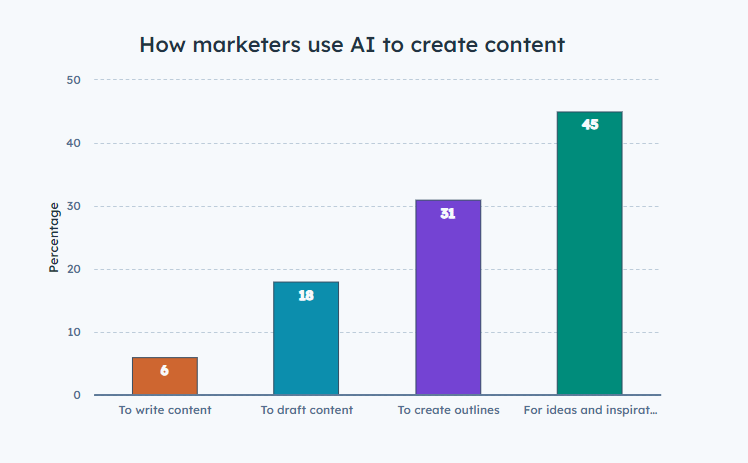
Only a small percentage of people trust AI to completely write their content. The largest portion chooses to use AI technology to build an easier method for writing, drafting, getting ideas, and creating outlines.
Something that’s still up in the air is how far marketers want to push AI in terms of creative control. Sure, automation is convenient, but hand over everything and you start to lose that unique brand touch—the weird little turns of phrase, stray jokes, or references that show you there’s an actual person somewhere behind the curtain. So the approach now seems way more like: let the machines do the grunt work, but keep the final brushstrokes for a human hand. It’s not a question of “Will AI replace us all?” so much as “How do we make AI work for our specific voice?” Everyone’s still tinkering with that balance.
And even as AI-generated content gets slicker, a lot of marketers have become pretty good at spotting when something was spat out by a bot. There’s a sameness, a kind of over-optimized blandness, that sneaks in no matter how clever the prompt. People can tell. It’s a little like watching a CGI character try to cry—you see the effort, but you don’t actually feel anything. So while everybody’s experimenting, nobody’s in a hurry to throw out the old creative process just yet. Maybe in a year or two the line will blur more, but in 2025, most folks are still leaning pretty hard on the “human in the loop” idea.
After using AI for months, it is still easy to identify when content is 100% written by artificial intelligence. It lacks a human touch, and we can see that the structure, words, and expressions used are mostly the same in all cases.
This lack of originality prevents content creators from using AI to write everything they need from scratch.
Indeed, the lack of a human approach to emotions and “robotic writing” concerns marketers, making it difficult to trust a machine to write a full piece of content. It may lead to some issues, like text that is not original, does not connect to business goals, or has no personalization.
That helps us understand why most marketers prefer to draft content themselves and get inspired. The report confirms this by showing that 77% of marketers felt that AI helped them craft more personalized content by merging human creativity with AI tools.
“This aligns with the prevalent trend seen in platforms like WriterAccess — an integrated model with AI tools. They use AI for initial content creation and human writers for refinement, fact-checking, and adherence with the brand’s tone and voice.” State of Marketing Report 2025
Every Rose Has Its Thorn: Top AI Concerns From Marketers
AI technology is great, but it’s not all sunshine and rainbows. According to the State of Marketing Report 2025, 60% of marketers using AI are concerned about it. Here are some of them:
- Job displacement: Automation through AI might lead to job losses in certain marketing roles.
- Bias, plagiarism, and brand safety: AI models can perpetuate biases present in the data they are trained on.
- Security risks: Data security breaches pose a threat when using AI.
- Lack of user knowledge: Marketers need proper training and understanding to effectively utilize AI tools.
These issues make sense, especially when talking about something that is new and may offer so many outcomes. As a marketer, the ones that I see that are more important to take care of are bias, plagiarism, and brand safety, which are more likely to happen when you don’t merge AI and humans.