

If you work with Content Marketing and SEO and haven’t been on a desert island with no internet for the past two months, you’ve probably read and heard a lot about Google’s March 2025 Core Update.
It was a huge milestone for the world’s most relevant search engine’s algorithm.
The update was completed on April 19, 2025, and according to Elizabeth Tucker, Product Management at Google, the initiative resulted in a 45% reduction in the volume of content considered of low quality or not very useful as search results — the initial prediction was 40%.
After this official conclusion, you may have noticed a drop in traffic, positioning, and keywords on your website. Or maybe you are simply a little lost. What to do now?
Come check out and understand the main consequences of this update and what you should focus on at the moment!
Google March 2025 Core Update: what exactly happened?
Launched on March 5, 2025, this update addressed a series of complex changes, aimed at improving the quality of search results by fighting spam practices and low-quality content – and was followed by a lot of buzz, especially with manual anti-spam actions that resulted in the complete removal of low-quality websites from Google search results.
After 45 days of large-scale implementation, the update was completed on April 19, 2025, but Google only announced it on April 26.
The idea behind the update was to prioritize delivering more useful and relevant information to users by prioritizing web pages with original content and a positive user experience, while reducing unoriginal material in search results.
Additionally, new and improved anti-spam policies have been implemented, focusing on areas such as abuse of expired domains, abuse of content at scale (such as those made with AI without human editing), and abuse of site reputation.
These measures aimed to reduce the volume of low-quality and spam content in search results – which was achieved, as I mentioned in the introduction, with a 45% reduction in this type of content.
With this, Google discontinued the Helpful Content Updates, as its system is now incorporated into the core update system. The latest one, released in September 2023, has had a significant impact on several websites.
Other changes
In addition to the substantial changes to content evaluation and ranking, the Google March 2025 Core Update also brought important tweaks in other fronts.
First, the help center page has been updated, providing detailed guides for website owners on how to solve Google Search ranking drops.
Additionally, the company has introduced a new feedback form for unusual changes in ranking, allowing site owners to send feedback directly to the Google Search team. Please note: it will only be available until May 31, 2025.
On the form itself, Google indicates that feedback is not used to adjust specific queries, specific listings, or specific sites. It is only used to consider general improvements that may work across general searches in the future. Google teams will not respond to these submissions.
The March 2025 core update represents an evolution in the way Google evaluates the relevance and usefulness of the content displayed to users, highlighting the focus on providing a more satisfactory and informative search experience for users’ questions. All of that is even more anchored to good EEAT practices.
EEAT is the acronym for Experience, Expertise, Authoritativeness, and Trustworthiness. It represents the criteria Google uses to evaluate content quality based on these characteristics.
It’s interesting to think about how these changes have reshaped the competitive landscape, too. Plenty of people have argued this makes life harder for smaller websites or newcomers, but honestly, it’s not all doom and gloom. While the bar for quality is a bit higher (and that’s probably overdue), laser-focusing on the actual needs of your users has never been more rewarding. That said, it’s easy to get lost fiddling with “best practices” and forget about what actually makes content helpful or unique. Sometimes, chasing Google’s signals turns into a distraction more than a solution.
I’ve also seen a number of businesses worry that Google’s anti-spam crackdown is aimed at them, when actually, a lot of sites that tanked in 2025 simply leaned too much on templated or generic content—whether it was AI-generated or not. Google’s beef isn’t just with bots, it’s with laziness. There’s a bit of freedom in that realization, if you ask me. You have license to rethink what you publish and gut-check whether it actually does anything for the reader. And if you aren’t sure, maybe you’re already halfway to the answer.
Some affected sites are expected to get a new life with this March 2025 update, although like everything in SEO, it’s difficult to say that at this time.
Result analysis
After implementing your plan of action, it is essential to measure the results. Do this monthly, bimonthly, and quarterly, depending on the amount of content you produce regularly.
Assess the impact of your actions and adjust your plan as needed. Be prepared to make ongoing adaptations as you monitor and better understand the impact of the update on your website and your target audience.
Reflection on the current SEO scenario: The Verge case
During this major Google update, The Verge caught attention with a peculiar article titled “Best Printer 2024,” which was essentially a prank to test Google’s search algorithm. In short, they wanted to see how far domain authority alone could carry them in search rankings.
If you’re not familiar, The Verge is well-known for covering topics ranging from technology to culture, entertainment, and science. With a broad reach and a diverse readership, the site has built a solid online reputation. Its high Domain Authority score of 93 out of 100 shows just how influential it is on the internet, nearing the maximum score.
Even with some shady SEO tactics, such as link overload and the use of AI-generated content (made via Google’s Gemini) to mock the content itself, the article managed to rank impressively high in search results, reaching the top organic position for the ‘best printer’ keyword.
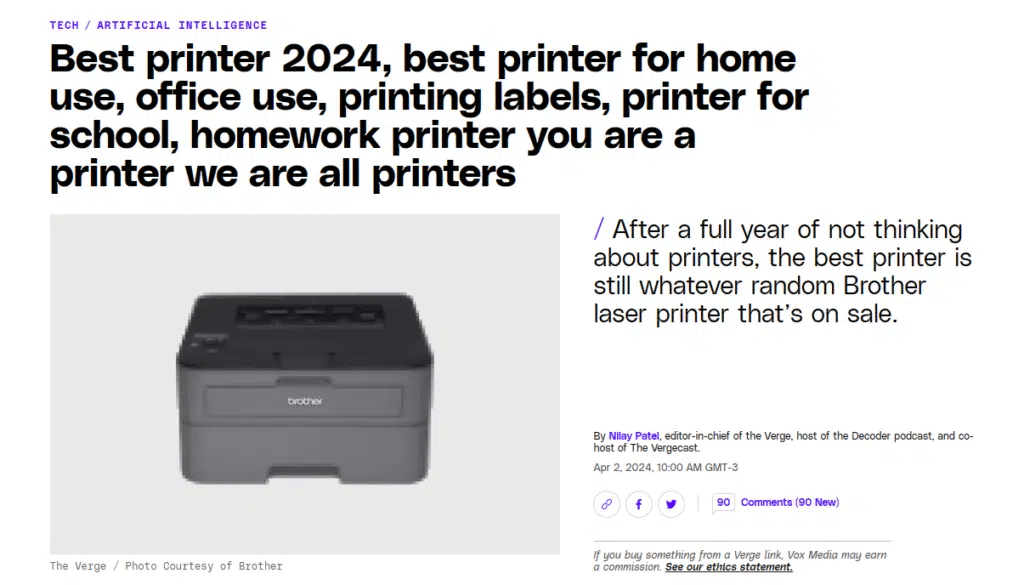
Article’s screencap : The Verge
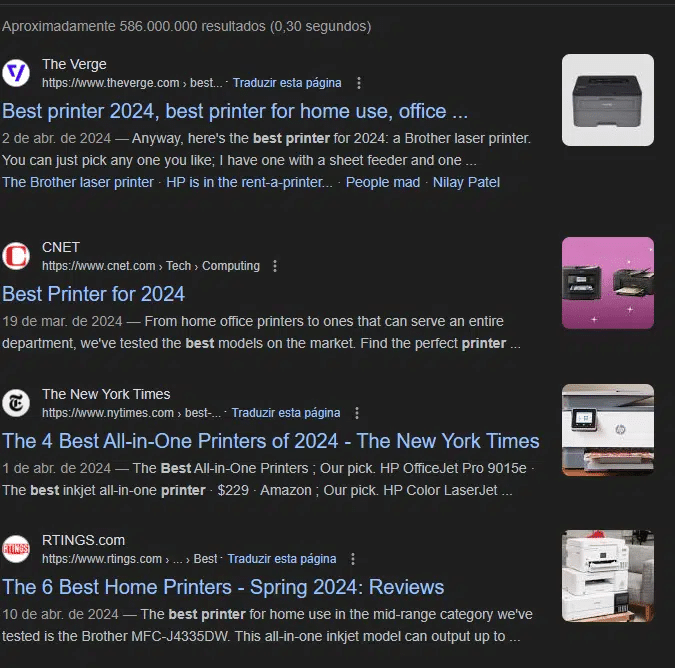
SERP’s date: 6/5/2024
Despite all the fun surrounding SEO strategies and The Verge’s troll article, it is interesting to note that, in the midst of all this, the article still offers useful information for users.
By highlighting the Brother laser printer as the best option for 2024, the author provides arguments based on his personal experience with the product and adds an extra layer of information about the strengths and weaknesses of the model, helping readers make an informed decision about their printing needs.
In the end, isn’t that what it’s about, answering the user’s question in the best way possible — even though it is not perfect?
This case study highlights how domain authority can be crucial to a page’s success in search results, but it also raises questions about the integrity of search results and the importance of following good SEO practices.
While some may be tempted to use dubious SEO strategies, remember that 1) You are not The Verge, 2) creating quality and relevant content for users is the key to a successful strategy in the long term.
Invest in quality content. Period.
All jokes aside, strategies trying to circumvent Google’s algorithm have existed practically since search engines were created. It’s a kind of cat-and-mouse game, in which some people try to find shortcuts to reach the top of the search results.
And yes, these tactics may work for a while, but Google is always updating its algorithms to detect and penalize deceptive practices.
We believe these “rank fast” strategies are not sustainable in the long term. Google values authority, relevance and quality of content. Building authority means having a solid track record, providing valuable information, and earning users’ trust over time. It’s about becoming a trusted source in your niche.
This means understanding your audience’s needs and interests, and creating content that answers their questions and solves their problems. It’s about being useful and valuable to your users.
Rather than trying to game the algorithm, we find it much more constructive to build relationships and provide high-quality content that keeps the audience engaged.
This will not only help you stand out in search results but also build a solid base of loyal followers and satisfied customers. It’s hard work and takes time.
Too long, Larissa. Can you summarize?
The Google March 2025 Core Update brought significant changes aimed at improving the quality of search results.
Focusing on original content and user experience, the update pushed back spam practices and low-quality content, reducing them by up to 45%. Additionally, stricter anti-spam policies have been implemented.
After the update, it is essential to carry out a traffic and performance analysis of your website, identifying drops in ranking and organic visitors.
Based on this analysis, develop an action plan, optimizing content linked to the most relevant keywords for your business and prioritizing the user experience. Then, monitor results regularly and adjust the plan as needed.
Instead of trying to game the algorithm, focus on providing valuable and relevant content to your audience.