

A few days ago, I wrote an article about the new AI tools introduced by Meta to streamline ad creation and increase campaign performance.
After 12 days, it was Google’s turn to announce its new features that, no doubt, have the potential to revolutionize the way we advertise from now on.
The news was announced during the Google Marketing Live 2025 event and surprised advertisers from all over the world due to the variety of tools and their different possibilities for improving results and streamlining the process of creating campaigns.
In this article, I’ll tell you about some of the new AI tools introduced by Google.
Google Ads: Conversational Experience
Creating really effective campaigns can be time consuming.
Planning and writing the copy, researching keywords and analyzing the competition takes much longer compared to actually running the campaign within the platform.
But, what if Google Ads, with all its intelligence acquired over all these years, could help you with that?
Well, it seems that day has come.
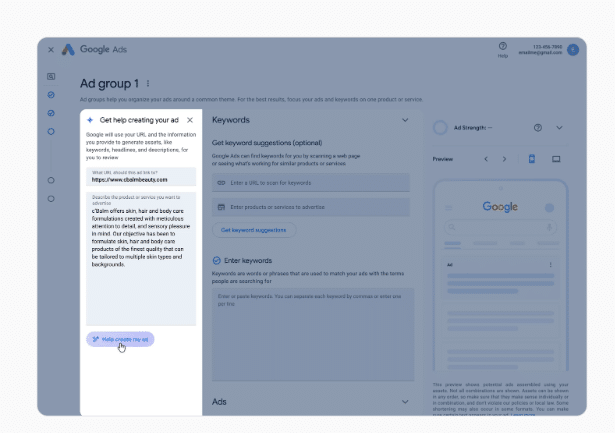
Google Ads is introducing a new conversational interface designed to streamline your creation and suggest the best titles, descriptions and keywords for your campaign through Artificial Intelligence.
See how it looks:
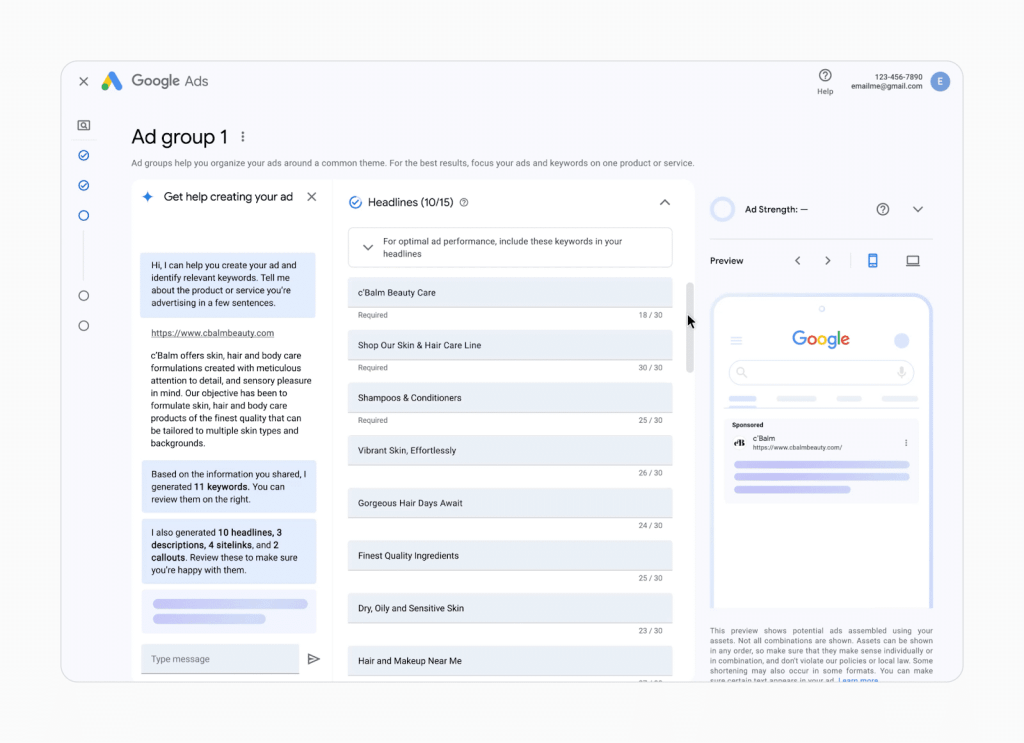
This is the headline creation section:
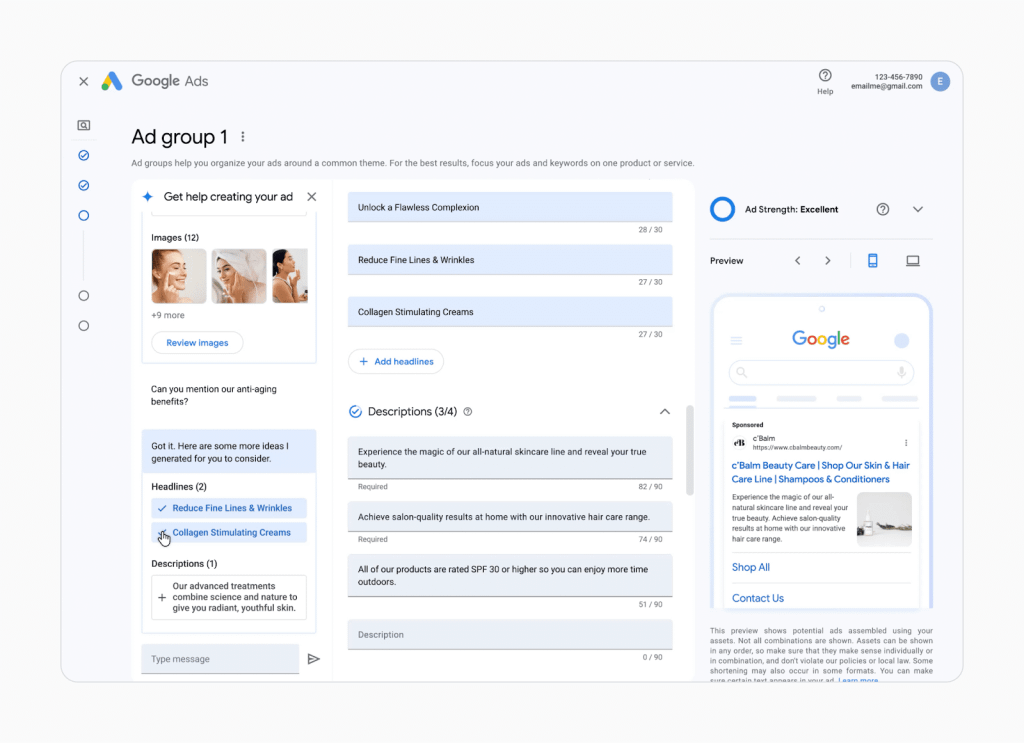
And also the description part:
Awesome, right?
All you need to do is input your landing page into the tool and Google Ads AI will automatically generate relevant and effective keywords, titles, descriptions, images and other assets to perfect your campaign.
The feature is optional, you can edit, revise or simply ignore these suggestions when setting up your campaign.
In addition, Google has introduced an AI powered chat that allows you to chat with the tool, as if you were talking to a coworker.
Through it, you can ask for suggestions, ideas and tips to improve your campaign and boost your results with the help of artificial intelligence.
Now, for anyone working in a team or agency setting, this interface feels a bit like your most organized colleague stepping in and sorting out the messy parts of brainstorming. Instead of back-and-forth emails (or Slack threads that go nowhere fast), you get comprehensive suggestions right there, in real-time, without the post-lunch lag. It’s not just about speed, either—the AI sometimes tosses out headline options you probably wouldn’t have thought of—some clever, some a little odd, but honestly, that’s part of the fun.
Plus, this is where the whole workflow starts feeling less robotic and more collaborative. There’s a difference between canned recommendations and something that feels (almost) like banter. I’ve caught myself rewording a suggestion from the tool, mulling it over like I would with anything a teammate said—maybe adding a bit more personality, trimming out a cliché, whatever fits. AI hasn’t replaced the creative process; it just sits in on the meeting, always awake, caffeinated, and happy to throw another idea into the mix.
Upon learning about this new function, you may be wondering: Does ChatGPT not have solutions similar to these? What should I use the Google Ads feature for?
Well, in the context of ads, it is possible to say that ChatGPT is still a child when compared to this artificial intelligence created by Google.
The reason? ChatGPT does not understand the context, dynamics and results of Google Ads campaigns as the platform itself does.
Generative artificial intelligence within Google Ads means having a machine with information and complete intelligence about the dynamics of ad titles, description, keyword, tool policies, and everything else important to deliver results that can really change the game of your campaigns.
However, one thing does not eliminate the other. Use these tools to further enrich your campaigns and have the critical sense to judge what should or should not be included in your ads.
Google Ads: Automatically Created Assets
Last year, Google launched Automatically Created Assets (ACA) for Search Ads.
Basically, the tool uses the content of a landing page and existing ads to automatically generate headlines and descriptions in your campaigns.
Soon, the company will enhance the ACA with generative AI to adapt ads much more effectively based on the context of the user’s query.
To exemplify this advance, Google demonstrated how the texts may appear if a user searches for “skin care for dry sensitive skin”.
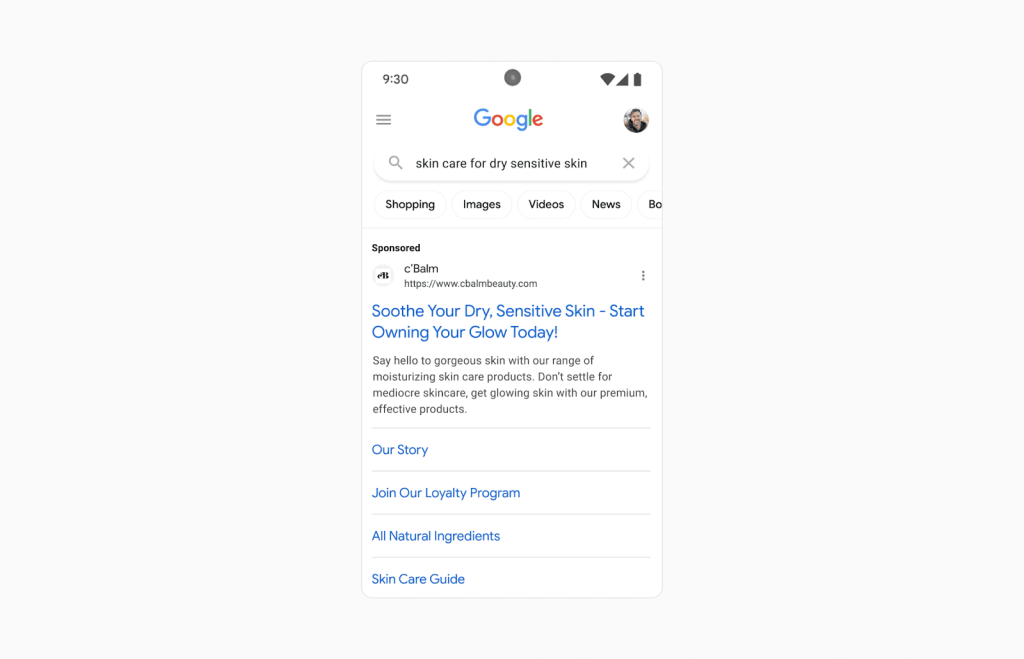
Automatically, Artificial Intelligence created the title “Soothe Your Dry, Sensitive Skin.”. Text extremely aligned with the search performed by the user and the content of the page.
Pretty cool, isn’t it?
Now imagine the ocean of possibilities that brands and professionals will have to increase the relevance of their ads and grow their results with the help of AI.
Conclusion
We are undoubtedly experiencing one of the biggest leaps that Google Ads has ever taken in its entire history – generative and conversational AI.
These new AI tools bring diverse and new possibilities for those who work with ads to create unique and effective campaigns that talk directly to the user, thus bringing even better results for companies.
We don’t know where this is going, but the advances in artificial intelligence in recent times have been so great that we can no longer underestimate its power.
The features released initially may not work the way we envisioned, but machine learning capabilities could advance it like never before.
Make good use of these resources and always have critical thinking to decide to what extent you will give up control to the AI or not.