

With the aim of making our lives easier, Google is introducing a new way to search the web using a combination of text and images at the same time.
Sometimes, it can be tricky to express yourself to Google, right? And sometimes, words are not enough. That’s why Google is going a step further in our direction to do research. The company just announced the Multisearch feature.
This means that, from now on, instead of typing into the search box, you can combine text and images to show the Google search engine exactly what you’re looking for.
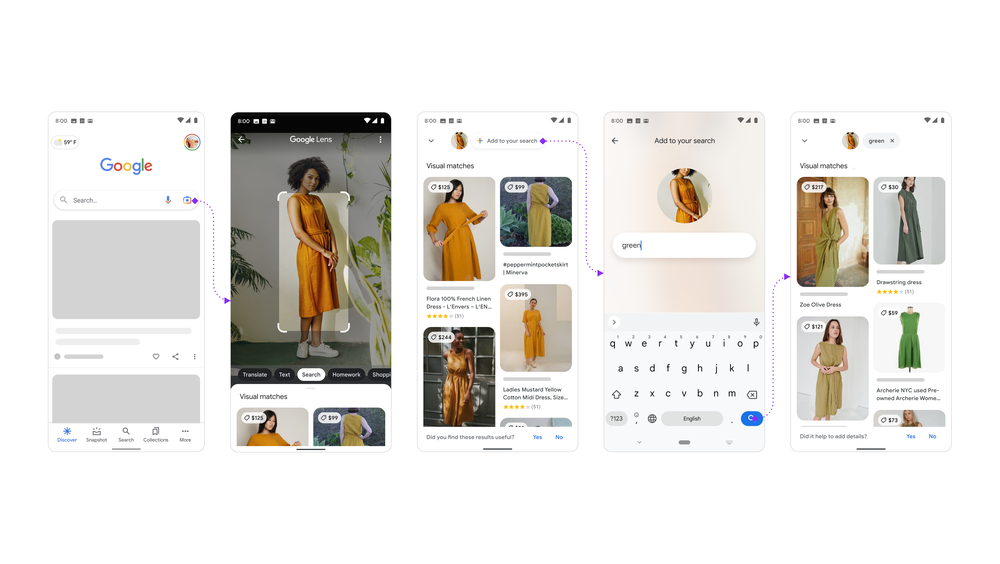
Let’s take a look on how this new feature works and how marketers can take advantage of it.
And if you like to receive articles like this directly in your inbox, consider subscribing to our interactive newsletter below!
How will Multisearch work?
For example, if you’re looking for a specific dress but with different colors, prices or sizes, now you can use a screenshot or photo of this dress directly from your gallery, and include some additional text. Much easier, right?
And you can also take pictures of things that you come across while walking down the street, and ask Google to find more information about them for you. A wall painting, a flower, a dress: anything that shines in your eyes.
And if you’re still not sure about the wonder of this new search feature, Google went a little deeper to blow your mind: you can send a picture of a table, for example, and ask Google to find the perfect chairs suggestions for it. Yes, you read that right: you’ll be able to have design tips just a click (or a photo) away!
Here’s the thing that’s kind of wild—while most of us are still getting the hang of voice assistants, suddenly we’re talking about snapping a photo and tossing in a few words to get super specific results. It almost feels like the future showed up while we were still fumbling around with autocorrect. There’s probably going to be a period where people experiment a lot, searching for combinations they never bothered with before. Not sure anyone has mapped out the ripple effect on niches like DIY or vintage shopping, but it’s definitely a shift.
What’s likely (and a bit exciting, honestly) is how visual content will suddenly matter a lot more. It’s not just about having sharp images—it’s about the images that people feel comfortable using in searches, the ones that don’t just look polished but instantly say, “Yeah, that’s it!” There’s going to be some trial and error, probably some frustration too, but those first brands who really get this probably stand to gain a lot.
One thing that might catch folks off guard is how this could gradually shift the kinds of search results we see. Imagine Googling home decor tips with a snapshot of your living room and a quick “add boho style” note—it’s going to blur the lines between inspiration, product recommendations, and practical advice. Some smaller businesses, especially those that lean heavily on unique visuals, might stumble into fresh audiences that used to slip right by on standard search.
At the same time, there’s a real possibility that search intent will get trickier to pin down. People are messy and impulsive when they search with images, and context gets… well, let’s just say a little unpredictable. This doesn’t just shake up marketers; web designers and content folks are going to have to think twice about how their assets might be interpreted—or misinterpreted—when they show up in a mixed-media search. In a way, it’s a bit like the early days of mobile optimization, except now we’re tossing a photo into the chaos and seeing what sticks.
What can you – as a marketer – expect from this new search feature?
For now, Multisearch is only available as a beta feature in the United States, with the best results for shopping searches. But this is something that we can expect to hear more often from now on. According to the Google Director of Search, Lou Wang, “Multisearch takes after the way we ask questions about things we’re looking at and is an important part of how Google views the future of research”.
And if Google sees Multisearch as the future of research, so do we. But as this feature is still in beta tests, at this first moment, we are not able to measure the impact of this new search feature on our digital and SEO strategy – although the Rock Content team is crazy to get their hands on it! But for sure, we’ll have a lot of opportunities to explore moving forward!
And how can you be prepared?
We’ll have a lot to learn from Multisearch when the feature is available worldwide. While we don’t have any more news from Google regarding this, we can get some insights and start working on our mindset.
One of them is obviously: SEO tactics have historically been about keywords. We are talking about finding the way people type questions and produce content to answer them.
Of course, things have been changing. Some years ago, we started discussing a lot about voice searches on Google, for example. The way people talk is different from writing.
Google has had its image search for a long time. But, now, it seems vastly improved. You are not just doing a reverse search to find the original source of a photo, for example.
You are putting together images, keywords and (why not?) voice searches. It’s a far more natural human-machine relationship. So, expect that some of the old SEO success tactics will soon no longer work.
Making a deeper analysis, we can see some customer-centricity in this approach. At the end of the day, Google wants users to find exactly what they’re looking for, without tricky questions or links. So the main goal of this improvement is to guarantee a more natural, assertive, and intuitive user experience.
And for now, I think this is the best tip that Google leaves with us. Regardless of how your digital strategy is built, it must be done by thinking about delivering real value to your customers. With that in mind, Multisearch will be a bonus in your strategy!